Before moving forward with a breast lift, you’ve likely heard the advice to look at before and after photos to get an idea of what your own results might look like. Many people, however, come into our Columbia, MD office not fully knowing what to look for in these photos, or even which ones are the most helpful to look at.
Here, we break down what exactly you are seeing from three examples of breast lift before and after photos so you can get a better idea of how to assess these types of photos yourself.
Case 1: A Standalone Breast Lift

This patient, 52, came in after losing about 50 pounds on a GLP-1 medication, a scenario that Dr. Chang and Dr. Wang are seeing much more of lately, since rapid weight loss often leaves the breasts looking deflated. To address that, Dr. Chang used a vertical, or “lollipop” lift, with an incision around the areola and straight down to the breast crease.
The nipple-areola complex was then repositioned higher on the chest without disrupting blood supply or sensation. Because no implant was placed, a good part of the work here was internal – reshaping the breast tissue to rebuild projection and a more conical shape, since deflated tissue after significant weight loss often doesn’t spring back into shape from skin tightening alone. You can see that the overall size of her breasts stayed the same in both photos.
The “after” photo was taken 3 months after her breast lift procedure.
Case 2: Breast Lift as Part of a Mommy Makeover

This patient, 51, had lost more than 50 pounds through diet and exercise and, after two pregnancies, was dealing with both abdominal laxity and breasts that had lost volume and drooped – a combination that made her a classic mommy makeover candidate rather than a single-procedure case. Her plan combined a vertical lift with breast augmentation and a full abdominoplasty in a single surgical session.
Pairing a lift with an implant is more technically demanding than either alone, since the lift is removing and tightening skin while the implant is stretching that same envelope back out. Thus, Dr. Chang has to plan the implant pocket and the skin excision together to avoid over-removing tissue and putting excess tension on the incisions or blood supply to the nipple-areola complex. Here, the lollipop incision technique was used, and the nipples were repositioned higher on the chest wall for a firmer, more youthful appearance. Dr. Chang was also able to achieve a modest increase in breast size using implants.
During the same procedure, this patient also had a tummy tuck to address the drooping skin and tissue in her lower abdomen after two pregnancies. You can see from the “after” photo that her belly button was also tightened and repositioned for a more toned look.
The “after” photo was taken 4 months out, and she was thrilled with her results.
Case 3: Breast Lift with Tuberous Breasts
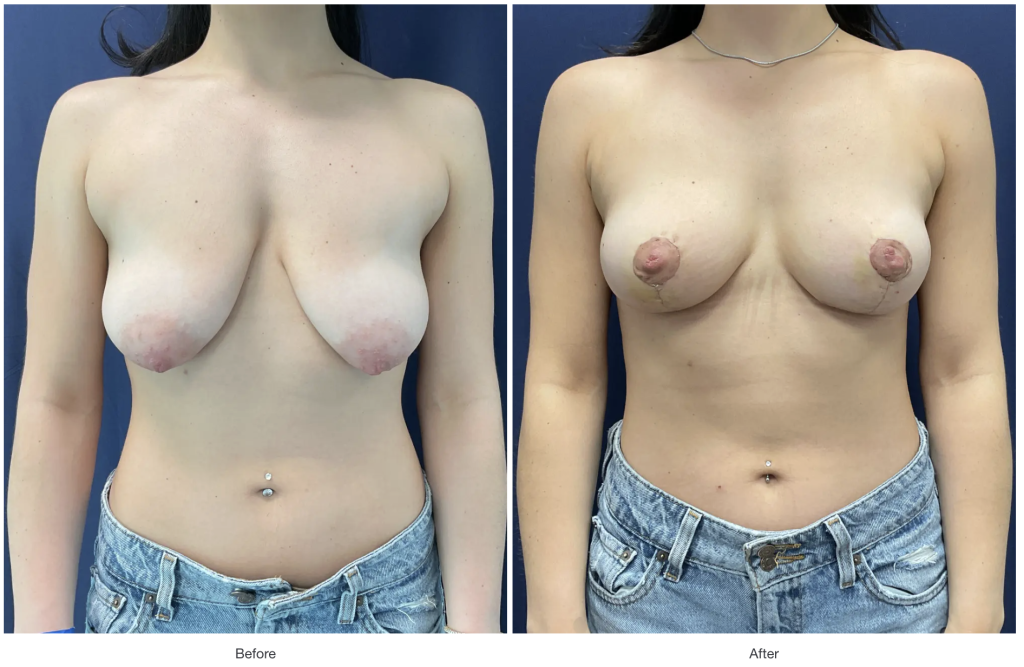
At 24, this patient was unhappy with the tuberous shape of her breasts, but was comfortable with her existing size, making her a great candidate for a breast lift on its own. Because of her age and the fact that she did not want implants, this patient was a good candidate for what’s called a short-scar vertical lift. This technique allows for smaller scars by leaning more heavily on the skin’s own elasticity to redrape smoothly afterward – which is why this approach tends to be reserved for younger patients with excellent skin elasticity.
You can see from the “after” photo that her breasts were reshaped to a softer, more rounded shape and her nipple-areola complex was repositioned higher on the chest wall.
She also received a PECs block, a regional nerve block placed between the pectoral muscles that numbs the chest wall at the source rather than relying only on systemic pain medication after sedation. This technique tends to shorten recovery and cuts down on opioid use afterward.
She was photographed at just 1 month after her breast lift.
Ready to See Your Own Transformation?
If you are ready to take the next step toward seeing your own breast lift before and after transformation, the first step is scheduling a consultation with Dr. Chang or Dr. Wang to discuss your goals. To get started, call our Columbia, MD office at 410-740-9330 or contact us online today.
Author: Dr. Eric Chang
Few plastic surgeons offer Dr. Eric Chang’s rare blend of impressive credentials and genuine compassion. After becoming a board-certified plastic surgeon, he returned to his home state and established Columbia Aesthetic Plastic Surgery, one of the premier cosmetic and reconstructive plastic surgery practices between Washington, D.C. and Baltimore.